Resources

Resources for West Virginia CRNAs, students, and patients

Licensure and continuing education, wellness support, careers, nurse anesthesia education in West Virginia, and patient information.

WV APRN licensure for CRNAs

An Advanced Practice Registered Nurse (APRN) license is required to practice as a CRNA in West Virginia. You need a WV RN Nurse Portal account to apply for an APRN license or maintain an existing one.

To apply for initial licensure, submit the application through the Nurse Portal, have the NBCRNA send official verification of your certification directly to the WV RN Board, and have your nurse anesthesia program send an official transcript showing the degree conferred and graduation date. If your program has closed, the AANA can send a certified copy of the transcript. APRNs who want prescriptive authority complete a separate Prescriptive Authority Application, available in the Nurse Portal once the APRN license is issued.

Use the WV RN Board's License Verification Portal to check your APRN license status and the NBCRNA certification expiration date on file. Your APRN license and NBCRNA certification must both be current to practice as a CRNA in WV.

APRN license renewal

  • Renew your APRN license every odd-numbered year by June 30. It must be renewed before July 1 to keep practicing.
  • All WV APRNs must also keep an active WV RN license. The RN renewal fee is waived for APRNs, but APRN licenses and prescriptive authority depend on an active RN license.
  • 24 hours of CE are required each two-year APRN license period: 12 hours in pharmacotherapeutics (advanced pharmacology) and 12 hours in clinical management of patients. Eight of the pharmacotherapeutics hours may also count toward Limited Prescriptive Authority renewal.
  • CE must be targeted at CRNAs or APRNs. CE designed for entry-level nurses doesn't count. The Board will likely not accept pharmacotherapeutics CE unless the certificate specifically designates it as pharmacotherapeutics or pharmacology.

New graduates: initial applications generally take about two weeks to process once complete. You must renew your APRN license and complete the 24 hours of APRN CE regardless of when you were first licensed. For example, if you're licensed in May of an odd year, you must complete the CE and renew before July 1 of that same year.

Keep your NBCRNA verification on file

Your APRN license becomes inactive if your NBCRNA certification expires or if the WV RN Board doesn't have current verification on file, regardless of the expiration date on your license. A lapsed license can mean fines, discipline, and a reinstatement application that may take weeks.

To send verification: visit the NBCRNA website, go to Quick Links, choose Request state board of nursing notification, and follow the steps. There's no fee. Keep a record of the request.

  • If you recertify in even years: request the notification be sent to the WV RN Board after you recertify. The Board bases your APRN license status on the last verification it received.
  • If you recertify in odd years: recertify with the NBCRNA before renewing your APRN license, then request the notification.

Risky scenario: if you recertify in an odd year but renew your APRN license first (say, May 1), the Board issues your license based on your old certification, which expires July 31 of that year. Request a new verification as soon as you recertify, before July 31.

WV RN license renewal

  • WV RN licenses renew every even-numbered year by June 30.
  • 12 hours of CE are required each two-year RN cycle. APRN CE can satisfy RN CE, but the cycles differ (APRN: July 1 of an odd year to June 30 of the next odd year; RN: July 1 of an even year to June 30 of the next even year), so make sure at least 12 hours fall within each RN cycle.
  • Within one year of initial licensure, anyone who will prescribe, administer, or dispense controlled substances must complete 3 contact hours on drug diversion, best-practice prescribing of controlled substances, and prescribing and administering an opioid antagonist. These hours can count toward the first APRN pharmacotherapeutics requirement. It's a one-time requirement.

Tracking your CE

The WV RN Board audits CE compliance, so keep certificates for every activity. CE compliance is verified electronically at renewal if you track it in CE Broker. To activate a free CE Broker Basic account, visit cebroker.com/wv/plans, choose Explore other plans, then Get Basic, and enter your license number. Activate one account for your RN license (for example, 12345) and one for your APRN license (APRN12345).

The WV RN Board accepts CE from nursing providers such as state and national nursing associations, national certification bodies, and any U.S. state board of nursing, as long as the target audience includes APRNs. CE you earn for NBCRNA recertification can count if it meets the content, timing, and hour requirements.

Titles and abbreviations

Under West Virginia APRN law and rules, APRNs must use the designation APRN along with their role title for identification and documentation, and wear clear identification showing the APRN designation when providing care. Document your name as, for example, John Doe, APRN, CRNA, and ask your facility to update your badge and roster to match. The preferred order is highest degree, licensure, then national certification, for example Jane Doe, MS, APRN, CRNA. Including your degree is optional.

Wellness & peer assistance

The AANA is concerned with the physical, mental, and spiritual well-being of CRNAs and student nurse anesthetists, and WVANA is equally committed to the health of West Virginia's own CRNAs and students. That commitment includes members who need help with chemical dependency and substance misuse.

Careers & job postings

Find your next role, or share an opening with West Virginia CRNAs.

CRNA Career Center

Search CRNA jobs nationwide on the AANA's career center.

Browse jobs

Post an employment opportunity

Share a current opening with WVANA members. Complete the form, and upload your messaging or email it to the WVANA office.

Submit a job posting

Becoming a CRNA

Nurse anesthesia is known for a highly respected educational system and a strong commitment to quality. Every accredited program is affiliated with or operated by an academic institution, and programs now award a doctoral degree for entry into practice, combining a graduate-level science foundation with extensive clinical anesthesia experience.

To become a CRNA, you must:

  • Be licensed as a registered nurse with critical care experience in the RN role.
  • Meet the admission requirements of a nurse anesthesia educational program.
  • Graduate from a program accredited by the Council on Accreditation of Nurse Anesthesia Educational Programs (COA).
  • Pass the national certification examination administered by the NBCRNA.

See the AANA's minimum education and experience requirements and resources for students.

About CRNAs

Nurse anesthetists have provided anesthesia care to patients in the United States for more than 150 years. The CRNA credential came into existence in 1956, and the title “nurse anesthesiologist” is synonymous with “nurse anesthetist.”

Prolific providers

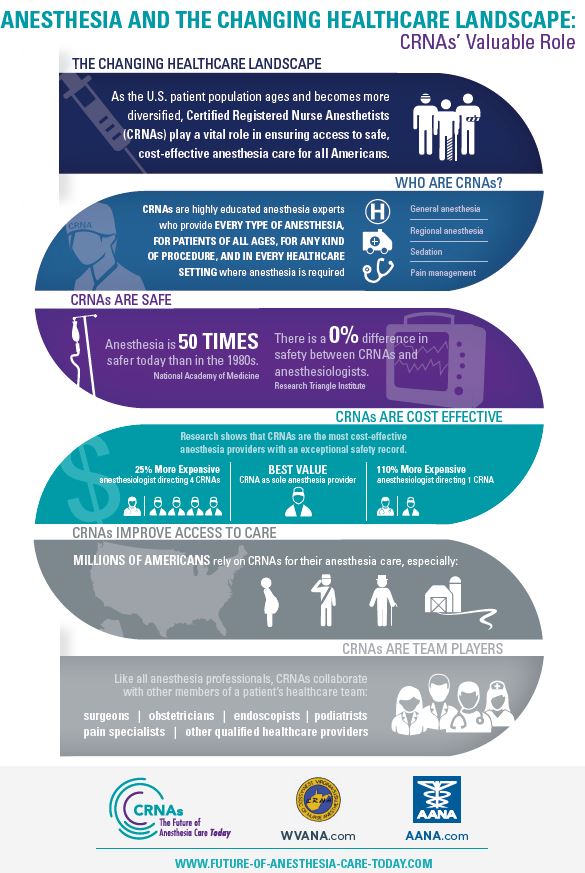
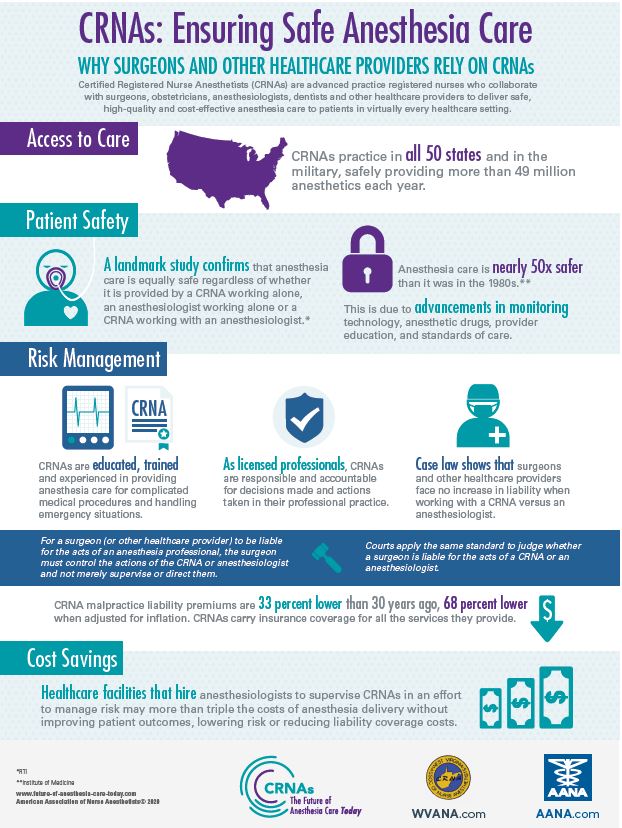
CRNAs safely administer more than 45 million anesthetics to patients each year in the United States, according to the AANA 2018 Member Profile Survey.

Rural America

CRNAs are the primary providers of anesthesia care in rural America, enabling healthcare facilities in medically underserved areas to offer obstetrical, surgical, pain management and trauma stabilization services. In some states, CRNAs are the sole providers in nearly 100 percent of rural hospitals.

Anesthesia safety

According to a 1999 report from the Institute of Medicine, anesthesia care is nearly 50 times safer than it was in the early 1980s. Numerous outcomes studies have demonstrated that there is no difference in the quality of care provided by CRNAs and their physician counterparts.

Practice of nursing

CRNAs provide anesthesia in collaboration with surgeons, dentists, podiatrists, physician anesthesiologists, and other qualified healthcare professionals. When a nurse anesthetist administers anesthesia, it is recognized as the practice of nursing.

Every setting

CRNAs practice wherever anesthesia is delivered: hospital surgical suites and obstetrical units, critical access hospitals, ambulatory surgical centers, the offices of dentists, podiatrists, ophthalmologists, plastic surgeons and pain specialists, and military, Public Health Service, and VA facilities.

Military presence

Nurses first provided anesthesia on the battlefields of the Civil War. Today, CRNAs remain the primary providers of anesthesia care to U.S. military personnel on front lines, navy ships, and aircraft evacuation teams around the world.

Cost-efficiency

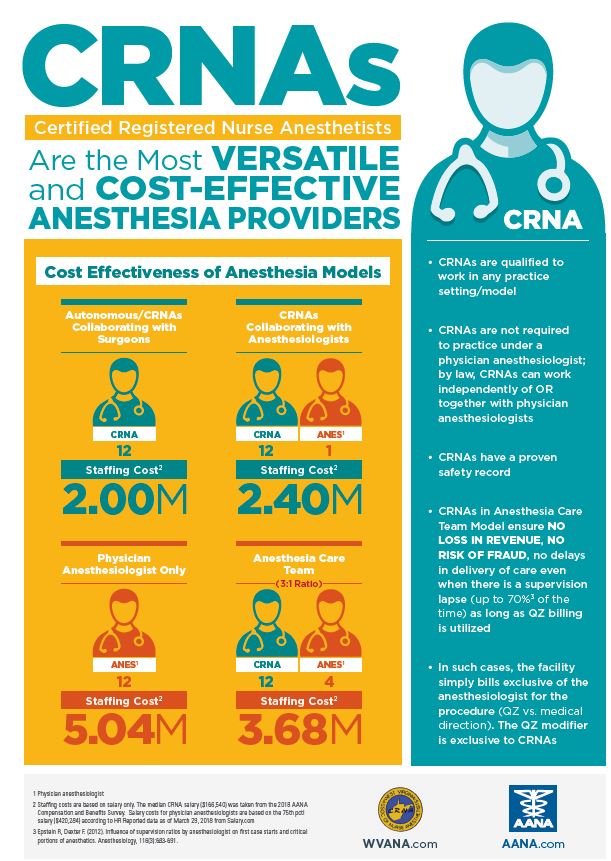
Managed care plans recognize CRNAs for providing high-quality anesthesia care with reduced expense to patients and insurers, helping control rising healthcare costs.

Autonomy and responsibility

As advanced practice registered nurses, CRNAs practice with a high degree of autonomy and professional respect, and carry a heavy load of responsibility.

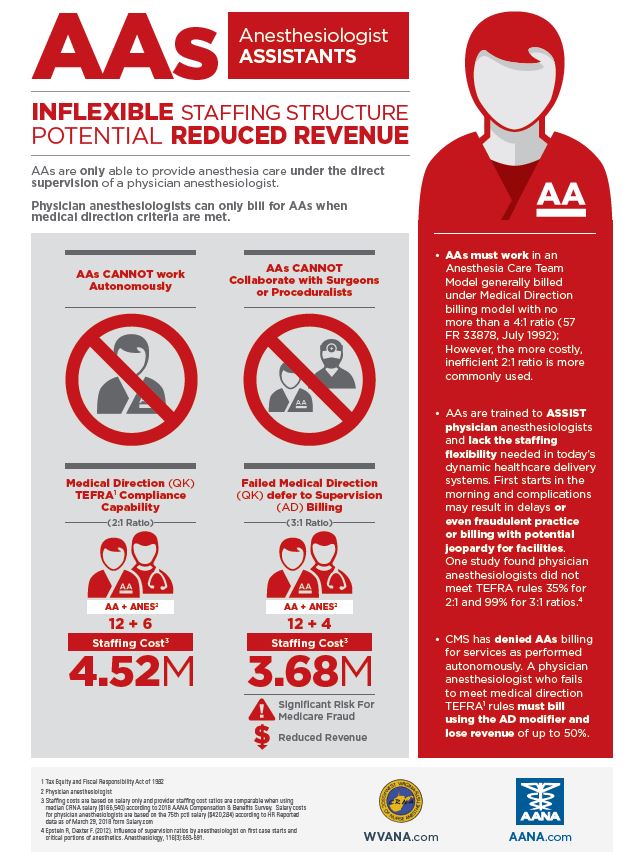
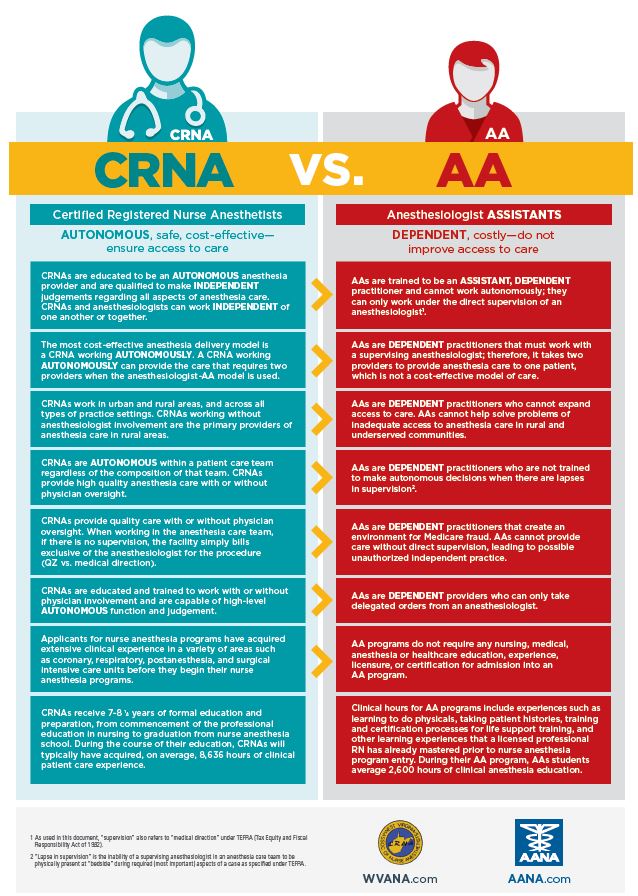
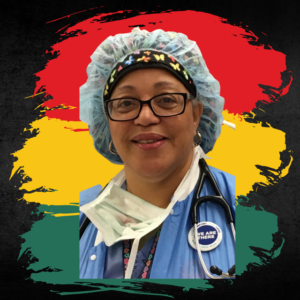
Download the infographics

For patients

What to know before your procedure, from the people who deliver your anesthesia.

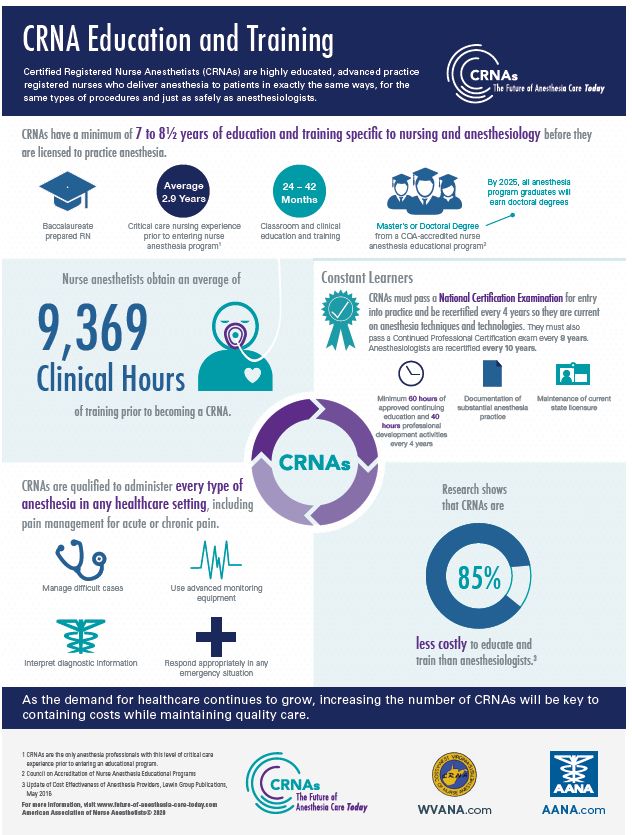
Anita C. Law, CRNA

Celebrating Black History: Anita C. Law, CRNA

“The seventh of 10 children, I grew up in a small coal camp in West Virginia. I first decided to become a nurse when my father became ill and I helped him with his medication. I pursued that dream and graduated from the WVU School of Nursing. After working in the field for several years, I decided to continue my education through nurse anesthesia. As a proud graduate of CAMC School of Nurse Anesthesia, I have spent most of my career working in hospitals in Beckley, WV.

My profession has been very rewarding and I encourage youth, especially African Americans, to consider an education in healthcare, particularly nursing. I will always remember Annette Hightower, the first African American to graduate from anesthesia school and work as a CRNA in WV. She was also the first African American CRNA I had the privilege to work with as a student. She was kind, soft-spoken and very knowledgeable. The first thing we did before we started our workday was to pray. We prayed over the anesthesia machine and we prayed for safe anesthesia and a good day. She was wonderfully encouraging to me as a student.

I strive to inspire the next generation to fulfill their dreams and encourage them to achieve higher education and reach for the stars.”

Anita C. Law, CRNA